When to Cut Hedges: Timings by Hedge Type
When to cut hedges depends on the species, but most formal hedges are trimmed in late spring and again in late summer, and beech, hornbeam and yew are often cut once in late summer. Always check for active nests first: damaging an active bird's nest is an offence under the Wildlife and Countryside Act 1981.
Last reviewed: by Natural Aspect Gardening
Published: by Natural Aspect Gardening, Epsom
When to Cut Hedges at a glance
- Formal hedges
- Up to three trims a year, mainly late spring to late summer
- Nesting season
- Main season early March to early August, but it can run longer
- The law
- Damaging or destroying an active nest is an offence (Wildlife and Countryside Act 1981)
- Native hedgerows
- Late summer to winter, or every other year in sections
- Neighbour disputes
- Evergreen hedges over 2 metres can fall under the high hedges rules
When should different hedges be cut?
When to cut hedges varies by plant. This table gives typical trimming times for the hedges we cut most often around Epsom and Ewell. Where a trim falls in the nesting season, check carefully for nests first.
| Hedge | Trims per year | When |
|---|---|---|
| Privet | Two to three | Late spring to late summer |
| Cherry laurel | One to two | Late spring and late summer |
| Yew | One to two | Summer and early autumn |
| Beech and hornbeam | One | Late summer |
| Leylandii | Two to three | Spring to late summer; never cut into old brown wood |
| Mixed native hedgerow | One, or every other year | Late summer to winter |
Is it illegal to cut hedges in nesting season?
Cutting a hedge in spring or summer is not illegal in itself. What is illegal, under section 1 of the Wildlife and Countryside Act 1981, is intentionally taking, damaging or destroying the nest of any wild bird while it is in use or being built. The RHS notes that the main nesting season runs from early March to early August and can go on longer.
In practice that means checking a hedge carefully before cutting, and delaying work on any section with an active nest until the young have fledged. Many people simply plan major hedge work for late summer, autumn or winter, which is the simplest answer to when to cut hedges if you want to avoid nests.
How should a hedge be trimmed?
- Check for nests along the full length and depth of the hedge.
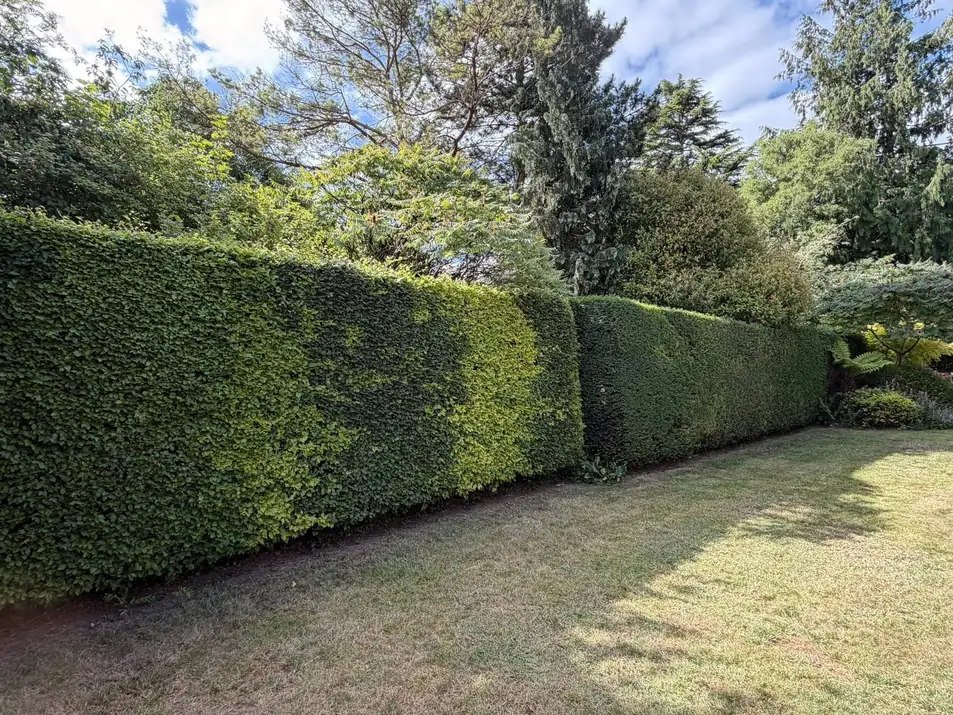
- Trim the sides with a slight taper so the hedge is wider at the base than the top. This lets light reach the lower branches and stops the base going bare.
- Cut the top level, using a line as a guide on long hedges.
- Clear the clippings from the base of the hedge, the lawn and the borders.
- Avoid cutting into old wood on conifers such as leylandii, which do not regrow from bare brown stems.
What can I do about a neighbour's tall hedge?
Try to settle it informally first. If that fails, the high hedges rules in Part 8 of the Anti-social Behaviour Act 2003 let you complain to the council about a hedge made of two or more evergreen or semi-evergreen trees or shrubs that is over 2 metres tall and blocks light or access. The council can decide a suitable height. GOV.UK explains the process.
Do I need permission to cut trees in a hedge?
Not usually for an ordinary garden hedge. But if a tree is protected by a Tree Preservation Order, or stands in a conservation area such as Ewell Village or Stamford Green and has a trunk more than 75mm thick at 1.5 metres high, you must notify or ask the council first. Conservation-area work needs six weeks' written notice.
Sources and further reading
Related guides and services
- How Often to Mow a LawnMowing frequency and cutting heights through the year, using RHS guidance.
- Planning Permission for a FenceThe 2 metre and 1 metre height limits and when you need to ask the council.
- General Garden MaintenanceOur garden maintenance service in Epsom and nearby villages.
- All garden guidesBrowse every guide in one place.
When to Cut Hedges FAQs
When is the best time to cut a hedge in the UK?
For most formal hedges, late spring and late summer. Beech, hornbeam and yew are often trimmed once in late summer, and native hedgerows are best left until late summer or winter after birds have finished nesting.
Can I cut my hedge in April or May?
Yes, but only after checking carefully for active nests. It is an offence to damage or destroy a wild bird's nest while it is in use or being built, so leave any section with a nest until the birds have fledged.
How often should a privet hedge be cut?
Privet grows quickly and usually needs two or three trims a year between late spring and late summer to stay dense and neat.
Why has the bottom of my hedge gone bare?
A hedge that is wider at the top than the bottom shades its own lower branches. Trimming with a slight taper, wider at the base, lets light reach the bottom and encourages new growth.
Can you trim my hedges in Epsom?
Yes. Natural Aspect Gardening trims hedges of all sizes across Epsom, Ewell and nearby villages and takes the clippings away. Call 07903085777 to arrange it.
Would you like a hand with this?
Our garden maintenance service covers Epsom, Ewell and nearby villages. Call 07903085777 for a quotation.